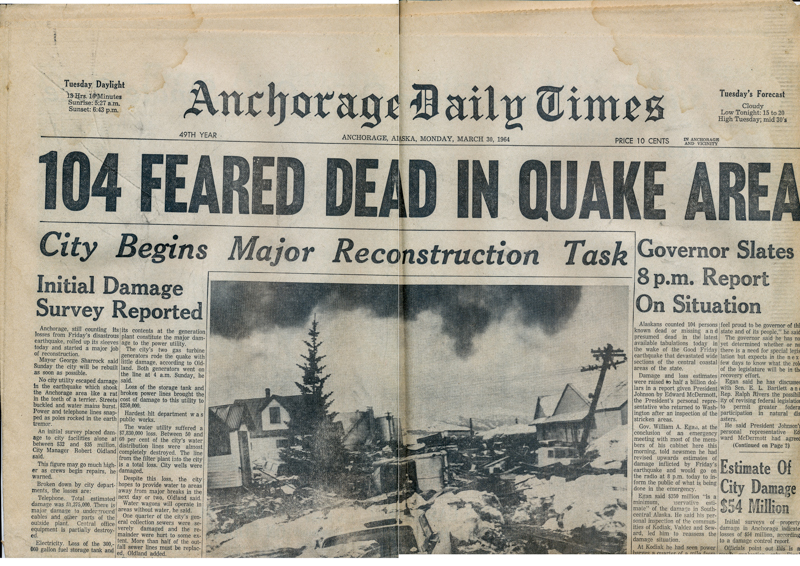
In the aftermath of the earthquake, the people of Alaska started taking stock and figuring out what to do next. A house blew up due to a gas leak, so we were told to move out until the utility could get to each home to check for leaks. I couch surfed for the next couple of weeks at a friend’s house, while my mother decamped to another friend. I headed to the YMCA to volunteer and was immediately put to work as a gofer.
The day after the earthquake, the military came to our neighborhood with a water truck and we all lined up for fresh water. My mother owned a restaurant so we weren’t short of food, but I did end up standing in line at the grocery store the following Friday (I think it was Piggly Wiggly) for canned goods. They were letting a few people at a time go in to buy limited amounts. I could peek through the doorway and see that shoppers were navigating through aisles with groceries still scattered here and there. They were selecting goods from the floor as well as the shelves. My interest in canned goods ended when we had a strong aftershock and I decided there was no way I was going into that building.
Also during that week I stood in line for hours waiting to call my grandparents to assure them that we were OK. Again, the military had set up a telephone bank so we could contact our families. One call per family.
For weeks after, I would wake in the middle of the night, knowing another shock was on the way. I would hear it coming, like a train approaching, and then the closet doors would start to shake. Everything would rumble, then I would hear it receding. Years later I told my geology professor the story of my experiences, and he was thrilled that I was the first person he had heard first hand describe the first set of waves (alpha waves move faster but are smoother) that precede an earthquake. That was why so many of us would wake in the night just BEFORE an aftershock started. Also why animals and birds seemed to anticipate an earthquake and start barking or take flight.

 Travels with Billie