And So It Ends

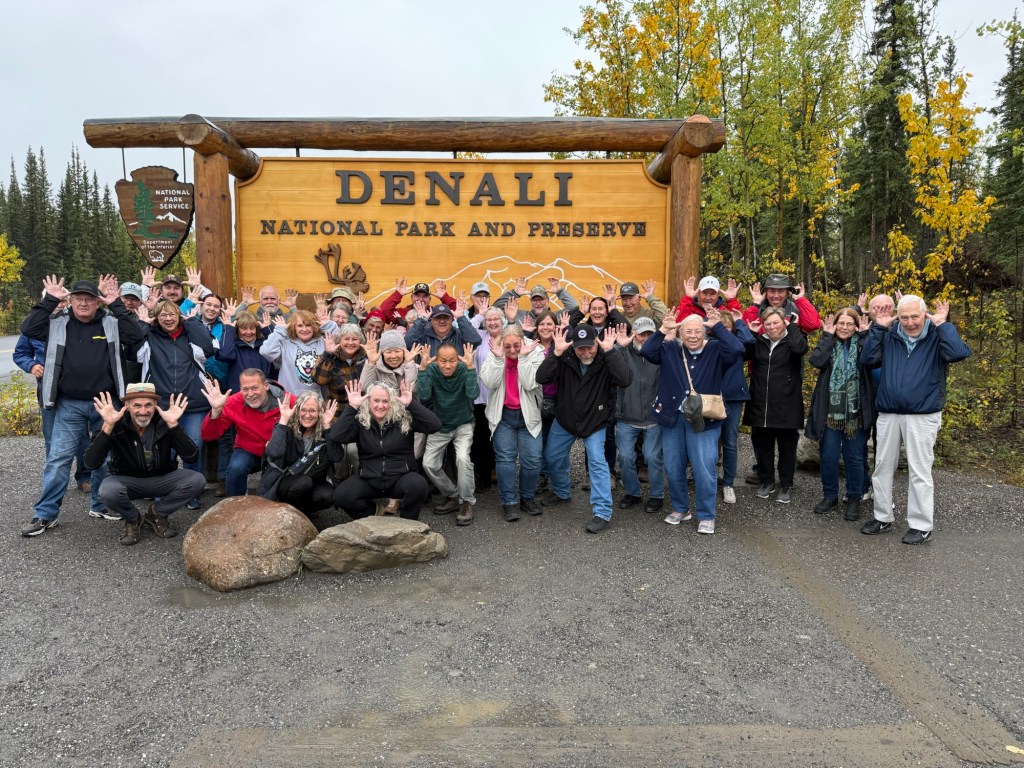
My final tour group.

The first phase of my year of travel is nearly over. My last tour ended yesterday and here I sit in the airport heading back to Anchorage. I’ll be heading down the road the day after tomorrow- the end of fifteen years of post-retirement seasonal work. My guests kept asking me if it was sad to know I wouldn’t be back. Not sad, really, but bittersweet.

In these years I’ve made wonderful friends, had amazing experiences, and had the privilege of sharing this gorgeous part of the world that I love so much. I’m so lucky.

Goodbye, Alaska. We’ll meet again, I’m sure.

Driving the Alcan

There are some moments that take your breath away.

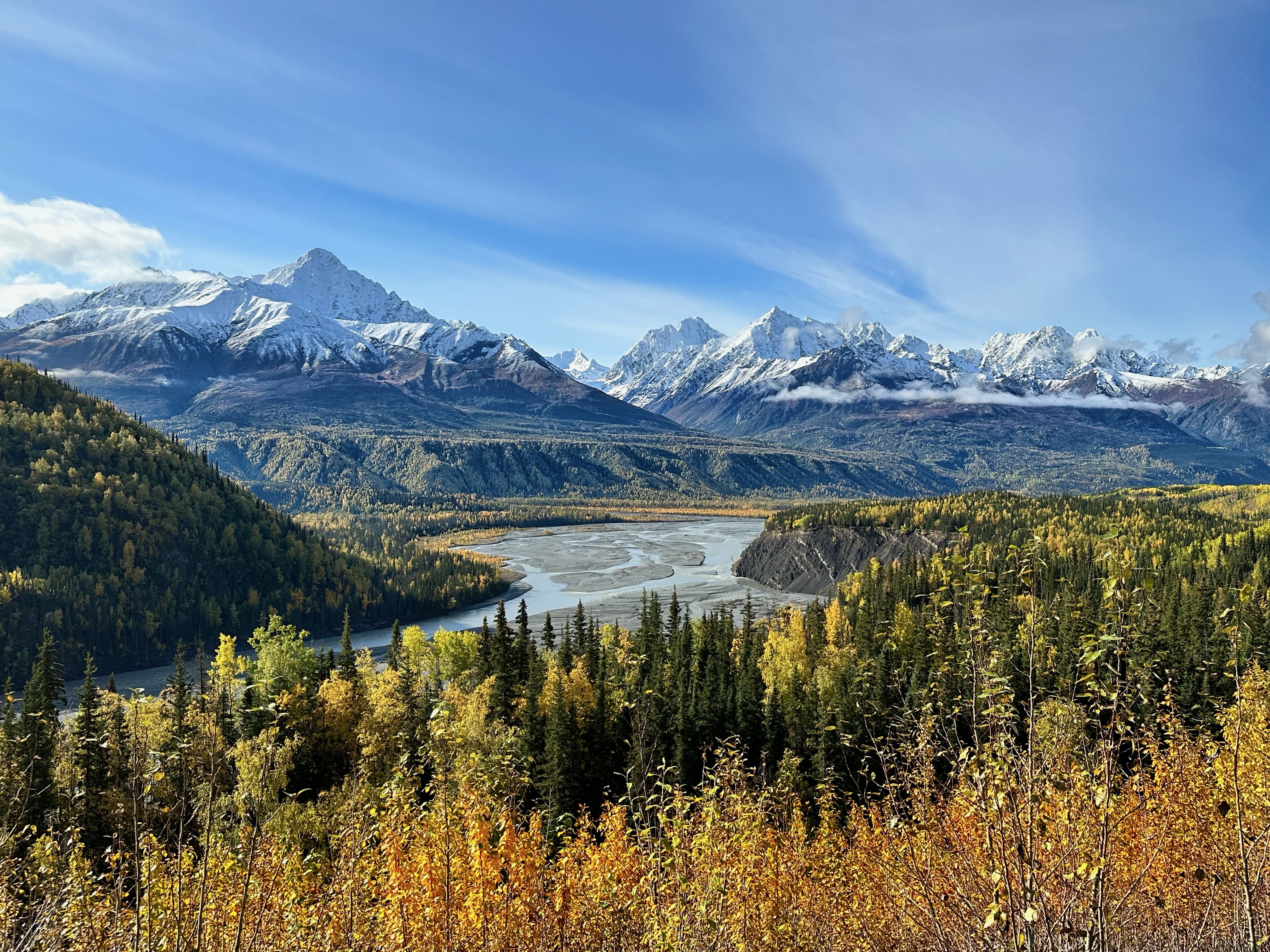
I began the long drive home from Anchorage at the end of my season as a tour director in late September

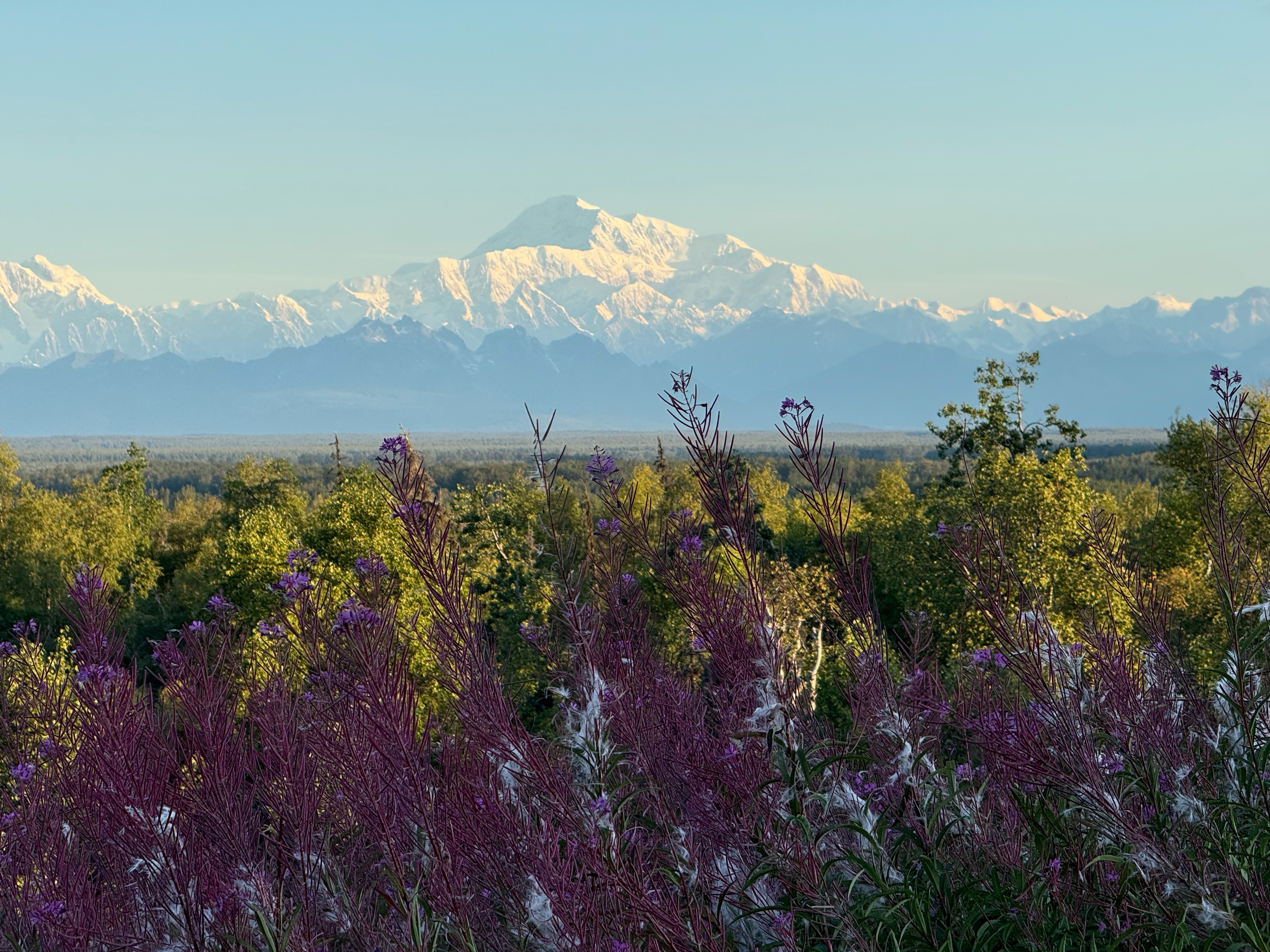
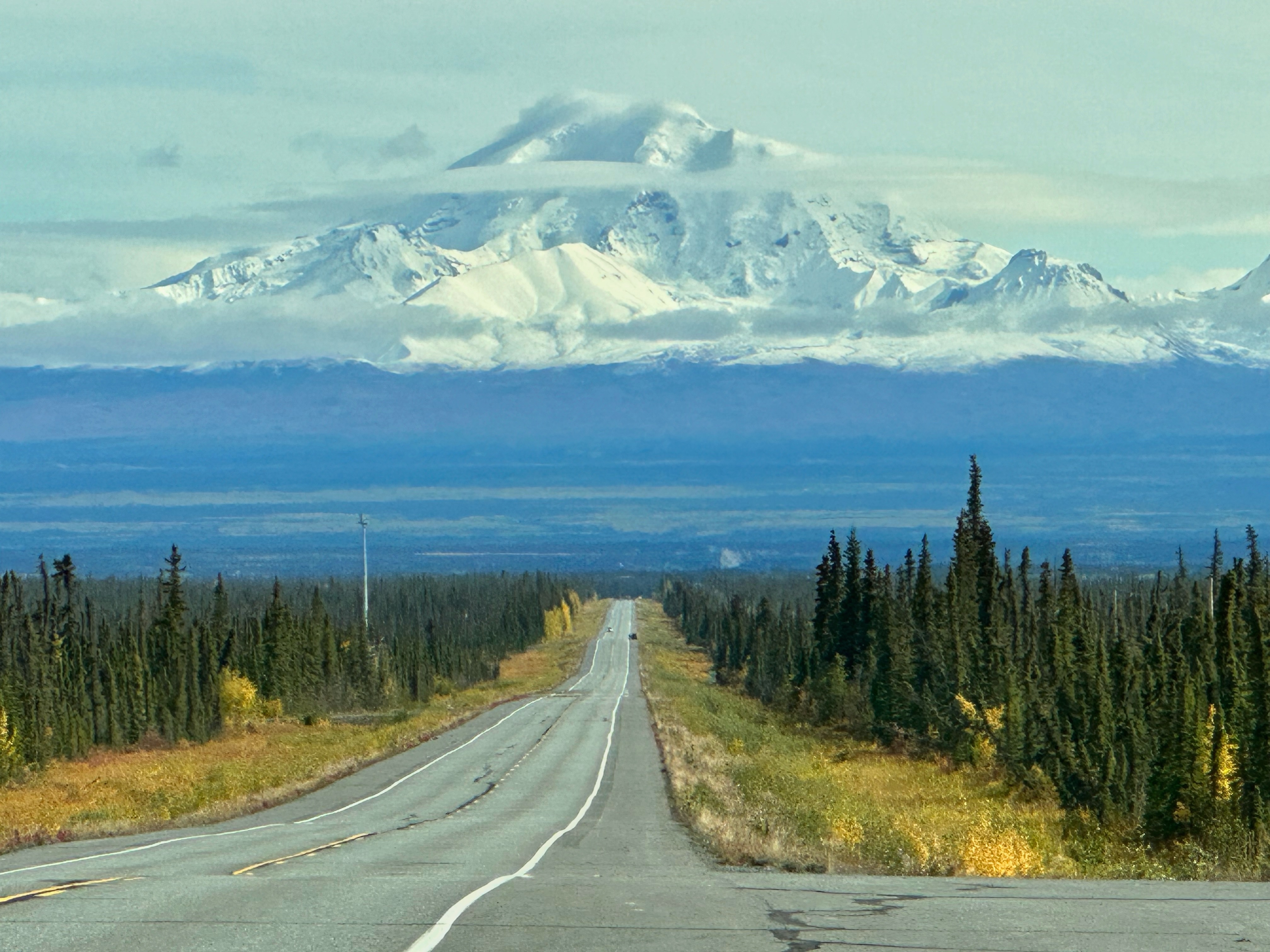
. I was tired, I was sick. REALLY sick. And I had forgotten how magnificent the drive is in the fall. The last time I drove this road was in 2019, and I was with my husband. This drive brought back those bittersweet memories, but I could still hear his amazement at the beauty of this area with the changing colors. I spent a lot of time on this trip pulling over and napping, since I wasn’t sleeping very well. Just imagine opening your eyes after a nap and finding Mount Drum staring back at you.

A Day of Darkness

What happens when a volcano blows its top?

As a child, sometimes it takes a little while for logic to kick in. I was outside one July morning in Anchorage, playing with the boy who lived in the apartment above us. We were absorbed in building a road with his Tonka trucks, when he looked up and said, “I have to go in now. It’s getting dark out and I have to go in when it gets dark.” I was annoyed at having our construction project cut short, but started to pick up our toys when it struck me. “Wait a minute! How can it be dark? We haven’t even had lunch yet.”

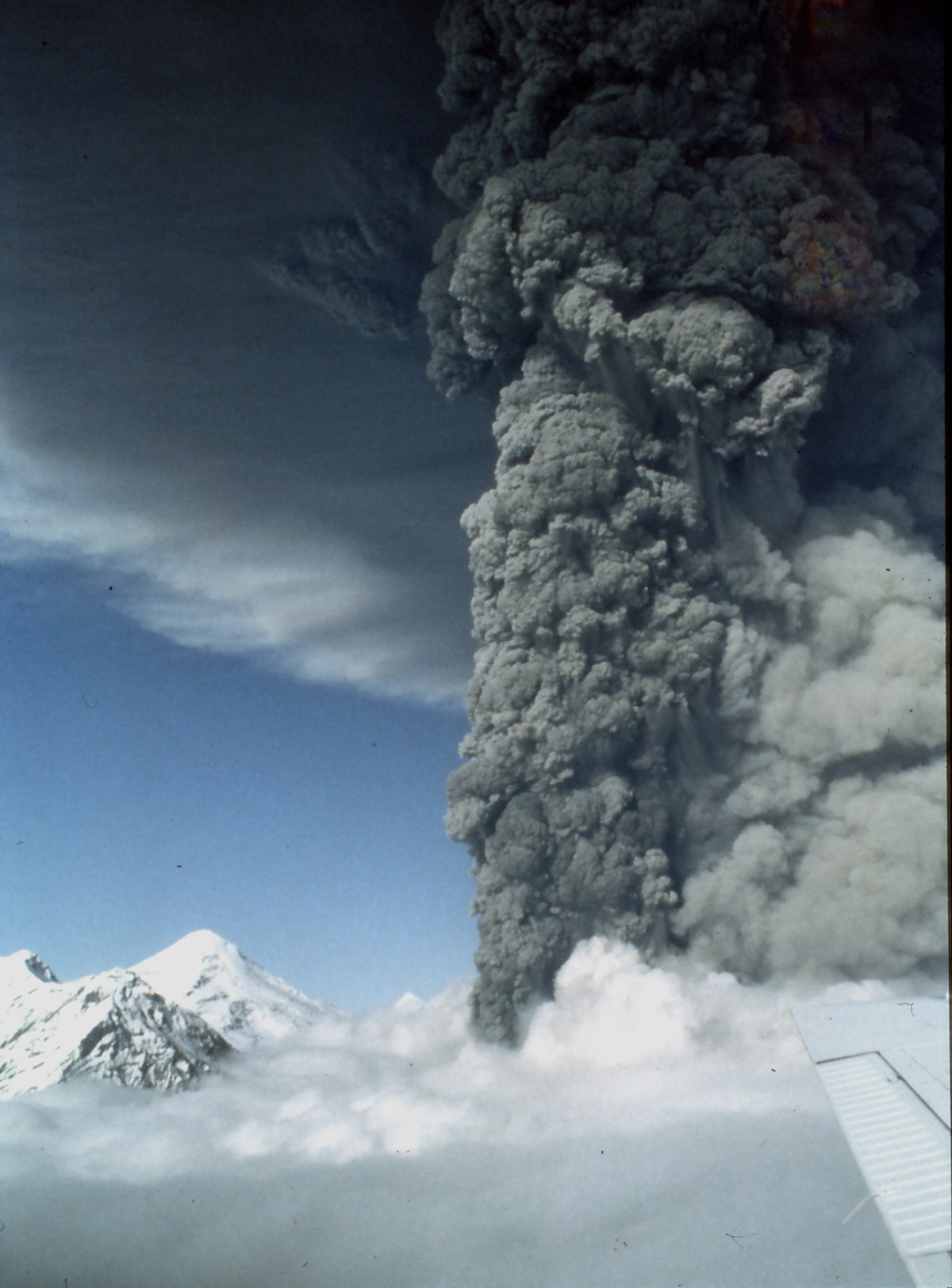
I went inside and told my mother it was getting dark out, and she immediately rushed out to take the laundry off the clothesline, thinking it was going to rain. Instead, she saw fine gray ash falling from the sky. She turned on the radio, and we learned that Mt. Spurr had erupted.

Alaska is a land of extremes. It’s big, it’s cold, it has gigantic mountains and vast tundra, nearly constant earthquakes (most too slight to feel)… and volcanoes. Part of the Pacific Ring of Fire, Alaska has more than 130 volcanoes, 50 of which have been active in the past 250 years. In fact, there have been more than 240 confirmed eruptions in that time. There have been several eruptions in recent memory that impacted Alaska, but this is the one I experienced.

The first thing my mother did was run back out to take the clothes off the line. The radio announcer was telling listeners that the ash would bleach the color out of wet laundry. More on that later.

Before long it was so dark outside that it was hard to see, despite the street lights having come on automatically. Most businesses closed, and my Dad came home telling us that it was getting dangerous to drive on the street, because you couldn’t see anything.

What I remember most was peeking out the door and seeing that fine ash, almost like talcum powder, falling from the dark sky, and the absolute silence. Nothing was moving, and whatever noise there might have been was muffled by the falling ash.

Anchorage ended up being covered with a quarter inch of ash, while some other areas of Alaska received several inches. Because it was so fine, it filtered everywhere. Everyone was commenting on how hard it was to find and banish the ash from cracks and crevices.

My mother complained longer than anyone, I think, and it was my fault. You see, when you’re seven years old in a town like Anchorage of the 1950s, you can find all sorts of interesting places to play. For instance, the construction yard down the street where they tossed the old tires from big heavy equipment. Those huge tires were a great place to crawl around and hide in. And after the volcano, the tire wells were filled with that powdery gray ash. I loved getting in there and touching the ash; it was so soft and pretty.

Now, we weren’t supposed to be playing in the construction yard, so our parents couldn’t figure out where all the ash was coming from. For weeks I would come home covered with ash, and of course, when my mother washed my clothes the chemicals in the ash would bleach them. I happily wore my clothes with all the little white spots on them, and never did tell my mother where we were finding the ash. To this day I can still remember the wonderful feel of that soft gray powder.

Sometimes a disaster in one way can be a boon in another way. You just have to figure out what to do with the ashes.

Good Friday Earthquake, Part 3

Random Tales from the Earthquake

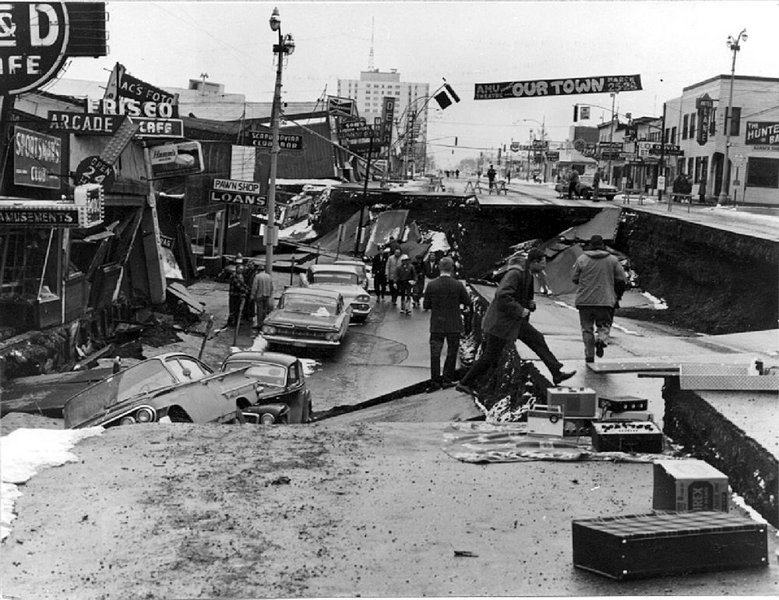
The woman who led our volunteer organization for servicemen was driving in downtown Anchorage. When the shaking started she pulled to the curb and stayed in the car. There was a man on the sidewalk next to her holding on to a pole with a sign stating “No Stopping or Standing”. After it was over they all just stared in shock, looking at each other. Then he looked up at the sign and said, “Well, I wasn’t really standing, you know.”

A local Anchorage store put a sign on their door that said, “Closed due to a shakeup in management.”

My mother had a friend who was a bartender in one of the bars that was part of the area downtown that sank 20 feet or so. He said there was a patron sitting at the bar who never moved from his barstool through the whole quake. After it was over, he proudly held up his glass and said, “I didn’t spill a drop!”

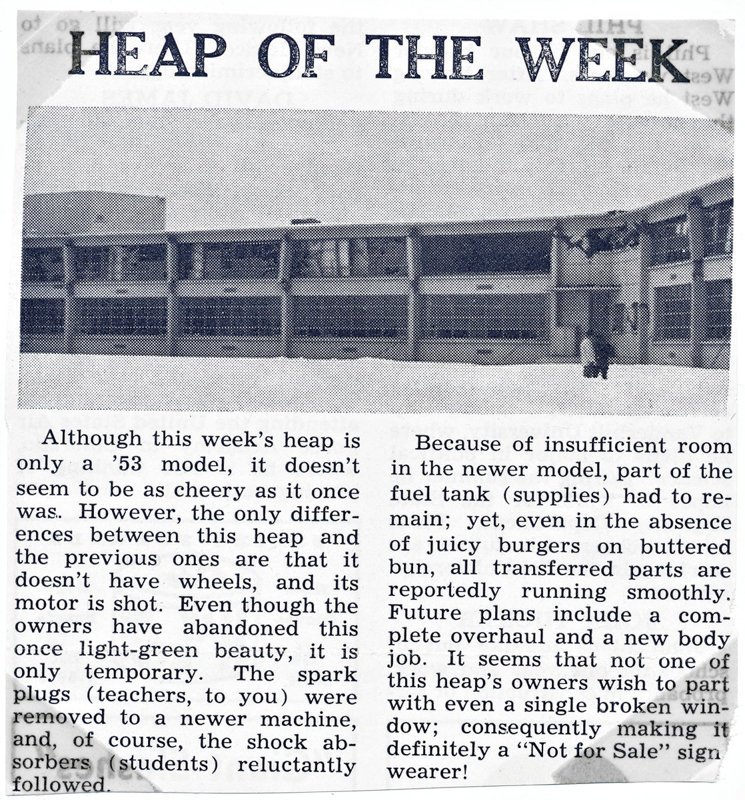
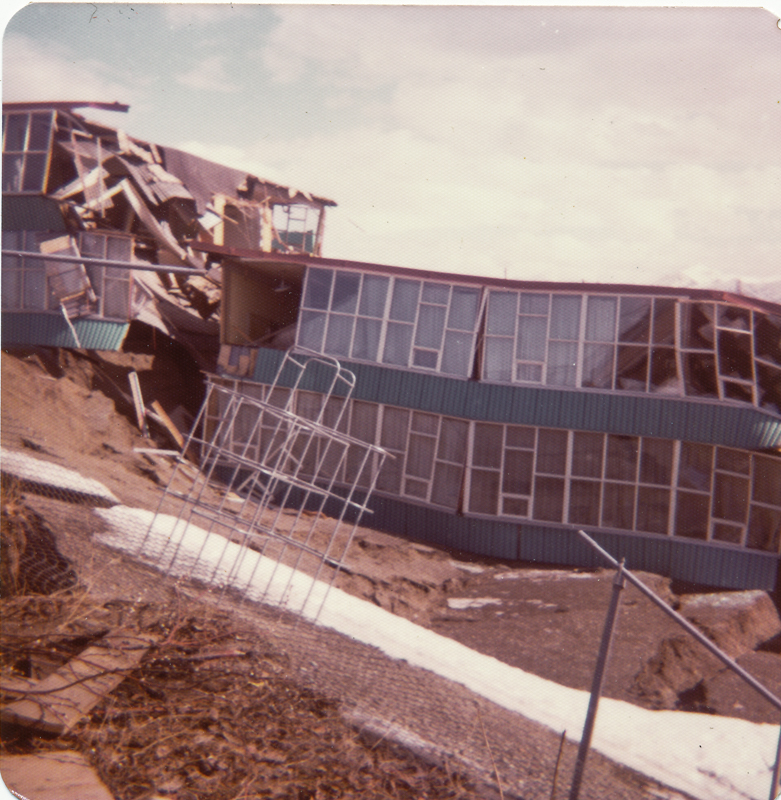
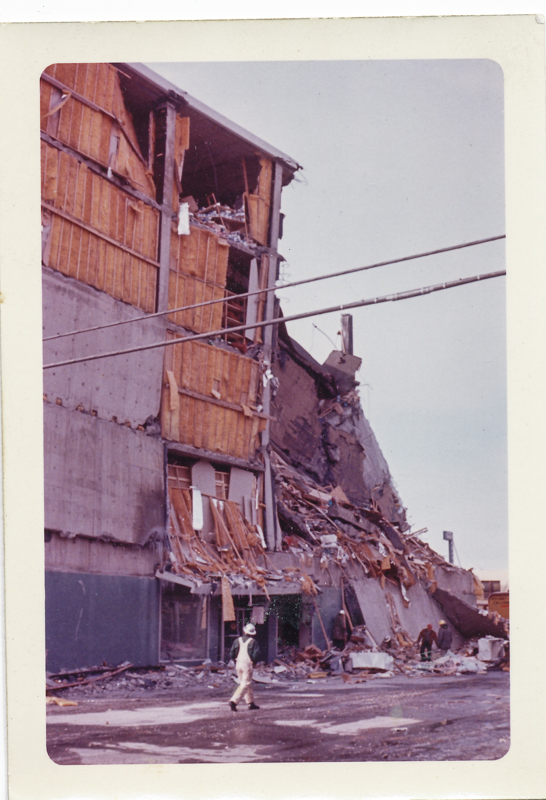
I was senior at West Anchorage High School, and the second floor of the school collapsed during the quake. We finished the year doing split shifts at East High. However, our graduation announcements, ordered months before, still held a drawing of the school. I sent them out to family and friends with a note telling everyone it was just the latest “Earthquake Joke.” West High is still there, but it’s only one story now. Although the main stairway still exists; it just doesn’t go anywhere.

Our senior prom was delayed, and we ended up having it at Ft. Richardson a week or two later than planned. And graduation, instead of taking place in the West High auditorium, was held in an airplane hanger on Elmendorf Air Force Base. It was an experience to remember!

While greatly damaged, Anchorage was by no means the hardest hit. Valdez was completely destroyed, with a large part of the town sinking into the sea. The town was relocated four miles away, where today it is the terminus of the Alaska Pipeline. Seward was also hard hit, first by a tsunami, and then fires from damaged fuel storage tanks near the docks. It was cut off for several days, since the Seward Highway and the railroad were impassible. Seward is situated on Resurrection Bay, wedged between the sea and the mountains, with only the one way in and out.

I got a first-hand report from a schoolmate, who had gone to Seward for the Easter break to stay with her mother, who worked there. She told me that after the shaking stopped she started to run to where her mother worked, but she was stopped by a man who told her they needed to go up the mountain. He pointed to the sea, which had emptied out a good portion of the bay. He knew what she didn’t: that a tidal wave was coming. Seward got not just one wave, but several. They ended up spending the night on the side of the mountain, along with many others. It was cold, so he gave her his jacket. When she told me her story, she said she never found out who the man was, but she still had his jacket. Oh, and her Mom was OK. She was also on the mountain, but in a different area.

Good Friday Earthquake Part 2

In the aftermath of the earthquake, the people of Alaska started taking stock and figuring out what to do next. A house blew up due to a gas leak, so we were told to move out until the utility could get to each home to check for leaks. I couch surfed for the next couple of weeks at a friend’s house, while my mother decamped to another friend. I headed to the YMCA to volunteer and was immediately put to work as a gofer.

The day after the earthquake, the military came to our neighborhood with a water truck and we all lined up for fresh water. My mother owned a restaurant so we weren’t short of food, but I did end up standing in line at the grocery store the following Friday (I think it was Piggly Wiggly) for canned goods. They were letting a few people at a time go in to buy limited amounts. I could peek through the doorway and see that shoppers were navigating through aisles with groceries still scattered here and there. They were selecting goods from the floor as well as the shelves. My interest in canned goods ended when we had a strong aftershock and I decided there was no way I was going into that building.

Also during that week I stood in line for hours waiting to call my grandparents to assure them that we were OK. Again, the military had set up a telephone bank so we could contact our families. One call per family.

For weeks after, I would wake in the middle of the night, knowing another shock was on the way. I would hear it coming, like a train approaching, and then the closet doors would start to shake. Everything would rumble, then I would hear it receding. Years later I told my geology professor the story of my experiences, and he was thrilled that I was the first person he had heard first hand describe the first set of waves (alpha waves move faster but are smoother) that precede an earthquake. That was why so many of us would wake in the night just BEFORE an aftershock started. Also why animals and birds seemed to anticipate an earthquake and start barking or take flight.

Alaska’s Good Friday Earthquake

One of the most significant events in my life was the Good Friday Earthquake, and I have a bunch of stories about it. To start, I’ll just describe what happened that day from my point of view. Later on I’ll do some blogs about other stories and facts about the earthquake. 

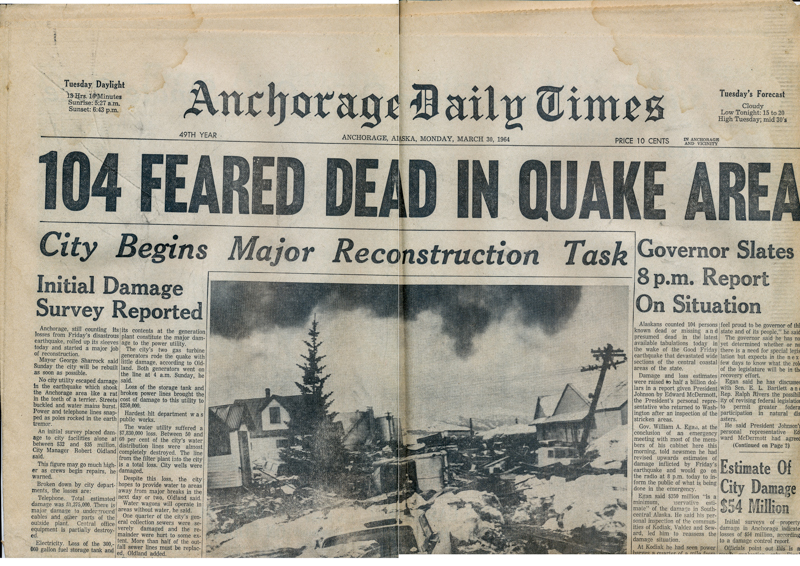
On March 27, 1964, a 9.3 earthquake hit Alaska at about 5:35 in the evening. If you’re not familiar with what that 9.3 means, it was the largest earthquake ever to hit North America. If you remember the earthquake that brought the World Series to a halt in San Francisco in 1989, that one lasted 15 seconds and was magnitude 6.9. The Alaska quake lasted FIVE MINUTES, and at 9.3 was 250 times stronger. It was so strong that it caused a measurable surge in the ocean in Australia!

For us, the earthquake started slow. I was a high school senior, at home in an Anchorage suburb, and in the process of giving a home permanent to a young girl who was staying with us at the time. We were at the kitchen table and I saw the hanging lamp over the table start to sway. As always, I said “We’re having an earthquake” and as always, my mother said “Nah.” Earthquakes were no big deal in Alaska and we had experienced many. They really weren’t much more than conversation fodder. I was just pointing out the light swaying when everything went WHAM! 

I moved to the kitchen counter, trying to hold the cabinets closed so I could save my mother’s china. I looked through the pass-through into the living room and saw our little dog narrowly miss getting crushed by our big console TV. She ended up cowering under the coffee table. At the same time everything was flying off the counters. There was sugar, butter, coffee, and everything else hitting the floor. When the coffee pot fell on my foot my mother shouted to me to let it all go and get out of the house. As soon as I stopped holding the cabinet doors every piece of china hit the floor.

At some point my mother said she thought it was the end of the world, because it was dusk on Good Friday. This from a woman who hadn’t been to church in thirty years.

About that time my old boyfriend stumbled through the door-what rotten timing! He had a shocked look on his face, and even more so when my mother ran to him (she never liked him). We all just held on until the shaking stopped, and then I started moving through the house trying to put things to right. It was clear that the movement had been mostly in one direction, because items on the North and South walls were thrown to the floor while the other walls were fairly stable. 

My first order of business was to take the water out of the toilet tank to rinse the permanent solution out of our young guest’s hair. Even that was a challenge, because the stacked washer and dryer in the bathroom had walked out from the wall to block the door. I ended up going outside and crawling in the bathroom window so I could push them back to the wall. Then I turned on our radio that received short wave broadcasts. When we heard calls for assistance in the Turnagain subdivision, my friend and I decided to drive out to see if we could help.  As we drove out we saw a lot of damage like broken windows in some businesses, but I don’t think the full impact of the disaster had really hit us yet. We knew it was big, but didn’t yet appreciate how big.

When we got to Turnagain my friend said he said he was lost and stopped near a group of people standing on the cliff overlooking the inlet. We walked over to talk to them and realized the reason he was lost was because most of the neighborhood was gone.  To my young eyes it looked like utter devastation. As far as I could see there were broken houses, and all I could think of was how many people might be trapped there, where we couldn’t get to them.

My friend was an announcer at a local radio station, so we decided to go help them get back on the air. When we arrived at the station, we had to help dig the announcer out, because there was a long hallway leading to the broadcast booth and it was blocked with tapes and records that had been on shelves lining the hall. The announcer was fine but he couldn’t get the door open!

We returned to my house, driving past my high school, and that was the first time I realized that the second floor had collapsed.  I was only two months from graduation and my school was gone! We got warm clothing and blankets for everyone. We had no electricity or water, but the radio station gave instructions on how to make snow safe to drink. We treated a little snow to get us through the night.  We tucked our young guest into bed, and my mom retreated to her bedroom with extra blankets and bottle of Dewars. To the end of her life she claimed that was the best antidote for cold. My friend and I spent the night listening to the radio. I wanted to sleep, but the occasional aftershock had me stressed out and I couldn’t really relax enough to sleep.  We listened to the lists of missing and the tsunami warnings. In time most of the names I recognized on the missing list were found…except for one. He was found under the collapsed front wall of the Penney’s department store.

It was the next day before we fully appreciated the extent of the damage. While Anchorage was hit hard, there were towns and villages that were completely destroyed, and a good part of the map of Alaska was changed. I’ll post more of the story, along with some photos, in the coming days.

Moon Over Ferry

Alaska’s homesteaders are a unique breed unto themselves.

In reviewing the old posts to my blog I came across one where I promised to tell the story of the “Moon Over Ferry” at a later time. 

This is one of my favorite stories to tell, and my coworkers and guests enjoyed hearing it on our tours through interior Alaska. It’s a bit long, so settle back and pretend you’re on a motor coach traveling from Fairbanks to Denali.

We are driving on the Parks Highway, which is one of the few major thoroughfares in Alaska. It connects Anchorage and Fairbanks, and was built in the early 1970s. Before then, the homestead communities in that area depended on the Alaska Railroad for transportation, mail, and freight. The little town of Ferry was one of those. There is a railroad bridge across the Nenana River, and just on the other side was a log cabin that served as the Post Office. The train would come through daily, exchange mail, and deliver boxes and packages. If you look down to the left you can see the river, and spot the occasional rooftop of a homestead in the far-flung community of Ferry.

When the Parks Highway was completed, the residents of Ferry put up mailboxes on the highway and the cabin was turned into a community center. It meant the good folks in Ferry could finally drive to Fairbanks or Anchorage to do their shopping.

Just one problem: the community was on the OTHER side of the river from the highway, and the only way across was the railroad bridge. That didn’t really bother the residents of Ferry, since they are an independent and inventive lot. They built garages on the highway side of the river, and used 4-wheelers to cross the railroad bridge to their homes.

Their use of the railroad bridge eventually came to the attention of the officials of the Alaska Railroad. Concerned for the safety of the community, as well as the risk to their trains, they posted a sign at the bridge that forbade crossing the bridge. 

Never underestimate the inventiveness and persistence of an Alaskan homesteader.

The good citizens of Ferry took down the sign and sent a letter to the officials in Juneau thanking them for the wood and the nails, since they are hard to come by in the bush country.

The railroad came back and bolted a metal sign with the same message.

Another letter from the citizens of Ferry to the officials in Juneau: “Gee, thanks for the bolts and the metal work. We could really use those.”

Finally, the railroad crew erected concrete barriers, preventing any motorized vehicle from accessing the bridge.

Undaunted, the good folks of Ferry decided they needed to send a message to the railroad. So every time the passenger train, loaded with tourists, came through Ferry, everyone in town would gather along the tracks and moon the train. Hence, “Moon Over Ferry.”

The railroad figured they would get tired of this gambit, but what they didn’t count on was the stubbornness of a bunch of homesteaders who could make the time to gather twice a day. And have fun doing it! A month went by, and still they mooned the trains.

Finally, the railroad officials gave in and built an addition to the side of the bridge just wide enough for a four-wheeler to fit. Success!

That’s not really the end of the story, though. The good folks of Ferry enjoyed their gatherings so much, that they decided to keep the tradition (just to remind the Alaska Railroad who was really in charge). On every fourth of July the entire community gathers for a cookout. When the afternoon passenger train comes through, everyone gathers by the tracks and moons the train as all the tourists snap photos of this unique Alaskan tradition. 

This story is true. Mostly.
Alaska As I Remember It

The Fourth of July. Usually it passes mostly unremarked here…we have guests to attend to, buses to run, vacation dreams to fulfill. Oh, we do have a cookout and some games, but it’s still a workday.

This year was different, however. I was invited to the celebration in the town of Ferry, which, until the day before, I didn’t even know existed. I have a distant relative, whom I’ve only met once before, who lives in Ferry, Alaska. My sister-in-law has encouraged us to get together, but it didn’t really register how very close they live. Anyway, my cousin-by-marriage called me the night before the 4th and invited me to come to their town cookout. It turned out to be much more than I expected, and a delightful time.

I agreed to come after work, and I got the directions of how to get to the town. It went along the lines of: drive to milepost xxx on the Parks Highway and take the Ferry Road (which, by the way, is unmarked) to the railroad tracks. Then turn left and follow the tracks until you come to a lot of cars. Wait there to be picked up. I did all that. There’s a railroad bridge that crosses the Nenana River. Shortly after I arrived, here came my cousin on an ATV over a walkway on the bridge. I climbed on the back of the ATV and off we went, back over the river to Ferry.

I walked into an Alaska I remember from my childhood. Our host was an true Alaskan old fart who welcomed me with a kiss on the hand and an offer of food. His hand-built log cabin is a step back into history, obviously hand-built. Their “community center” was at one time the post office-also a log cabin that was turned over to Ferry when the Parks Highway was built and mail started being delivered to mailboxes on the highway rather than by the train. It has a bar, a sitting area with an original barber chair, a pool table, and enough memorabilia to make an antique lover swoon.

I also got a tour of our host’s cabin. So here, in the Alaskan bush, in the cabin of this 80-something sourdough, sits a baby grand piano. How did it get there? Well, the good citizens of Ferry carried it across the railroad bridge. Ah, the railroad bridge. That’s a whole other story. It turns out that the town of Ferry is quite famous. Maybe I’ll write the whole story once I get it right from the mouths of those who know the real story-the residents of Ferry. For now, let me entice you with a promise to tell the story of the Ferry Moon.

But Ferry isn’t completely Alaska Bush. In fact, one of the folks there said they live in the “Cush Bush”. Yes, they are highly spread out (I didn’t actually see any homes other than our host’s-people in Alaska like their neighbors to be close enough to visit…but not too often). Yes, they have well water and outhouses. But they also have electricity and 4G internet and cell service. Turns out the cell tower is right in town.

The town fascinates me, and I assured both my cousin and my host that I’d be back to visit. I itched to take time to really photograph this remnant of Alaskana, but it didn’t seem polite. Next time I’ll take my camera, and ask permission. There are literally hundreds of photos sitting there waiting to be made.

Just a Moment

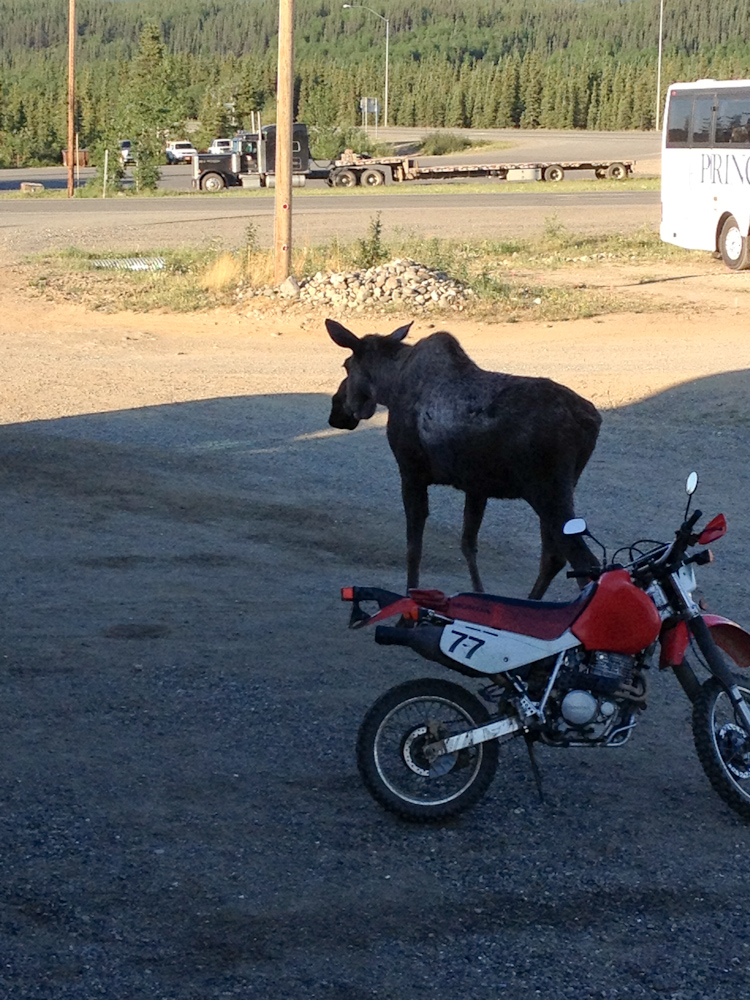
Sometimes an amazing moment happens so quietly, unnoticed by most.  This was one of those moments. The photo isn’t one of my best, but it captures something special so I’m going to include it here anyway.

The other morning I was leaving our housing to walk across the street to have breakfast at our larger facility, which houses our Employee Dining Room. Because it was early in the morning, no one was about, and I was focused on starting my work day.

I walked out the front door and onto the deck, which is only about 10 feet deep. I nearly walked right across and down the steps, but thankfully I noticed the moose that was standing right next to the stairs. I didn’t see her at first because there is a railing there and it blocked most of my view of her. I say thankfully, because moose, particularly females, can be very aggressive. You really don’t want to get into an argument with a creature who weighs over 1000 pounds, no matter how docile they might seem to the casual observer.

She was just standing there quietly, not moving, until I came out the door. She lifted her huge head and looked at me, standing only ten feet away. I was so astonished I just stood there and stared at her. It wasn’t until she started to casually stroll away that I came to my senses and started frantically digging for my iPhone to take a picture.

She walked across the parking lot, across the street, into the parking lot of the bar/restaurant across the street, and disappeared into the woods behind the bar. No one else was around, she didn’t run, she just slowly ambled away and into the woods. I stood there for several minutes looking at the place where she vanished into the trees, and finally  walked across the street to breakfast. It was almost like it never happened. Almost.

Image