On Coming Home Again

As I was digging into reviving my blog I found this piece I wrote but never posted. It was abandoned after one of my husband’s many trips to the hospital, and I simply stopped thinking about my blog. But in reading it, I decided it was worth posting, even if it’s a couple of years old. I’m going to backdate it, but I’m actually putting it up here in 2023. So here we go.

We recently received an invitation to our high school reunion, and one item in the itinerary seemed to define what it was like growing up in a small town: “Street Dance at the Stoplight.”

No, The Stoplight isn’t the name of a venue. It’s THE stoplight. The only one in town. The one they installed in the 50’s, welcoming it with a town celebration and a hula hoop contest. The light still hangs there, at the corner of Central Avenue and Main Street, also known as Highway 2. That’s the one that will hold you in this small town, although temporarily, if you are headed to Glacier National Park from Interstate 15.

I didn’t actually graduate in Cut Bank, but I was born there, and went to school there when I wasn’t in Alaska. I’ve been invited to all the reunions because of our shared childhoods. Probably the most important one was in 1986, when an all-decade reunion was held (you need enough graduates to make it a real party in a small town.) I flew there from New York City, met my junior-high boyfriend, and promptly married him and high-tailed it out of New York.

Having lived in a variety of places from an Alaska village to New York City, I can confidently say I’m glad I grew up in a small town. There are experiences you can’t have in a city, even one of moderate size. We could wander anywhere in town. If we made trouble our families heard about it. My mother came home from work one day and wanted to know why I was limping. Since I was sitting down, I couldn’t figure out how she knew. It seems someone saw me walking home and called her to ask about me. We had been swimming at the river and I stepped on a piece of glass. I didn’t want to say anything because I was afraid I’d have to have stitches. I got stitches.

Sleeping in the yard with friends was a summer tradition. I vividly remember staring up and seeing the Milky Way stretching across sky, discussing with my friends what we thought might be out there. Sometimes we would meet up with the boys, who were “sleeping” in one of their yards, and together we would raid gardens. Nothing quite as wonderful as a filched tomato right from the vine. I haven’t seen the Milky Way in decades. I miss it.

I remember standing at the edge of town and seeing the wheat fields, planted and fallow, stretching for as far as I could see, and aching to go. Anywhere. Just not there, in that little town. Today I look back and realize just how lucky I was to have grown up there. Yes, everyone knows your business. People knew the story of my background, the sordid and the sublime, long before I ever had an inkling of it. But that small world gave me friends, independence, little adventures, and a safe way to learn about the world. To borrow a line from Stephen King: “I never had any friends later on like the ones I had when I was twelve.”
A Day of Darkness

What happens when a volcano blows its top?

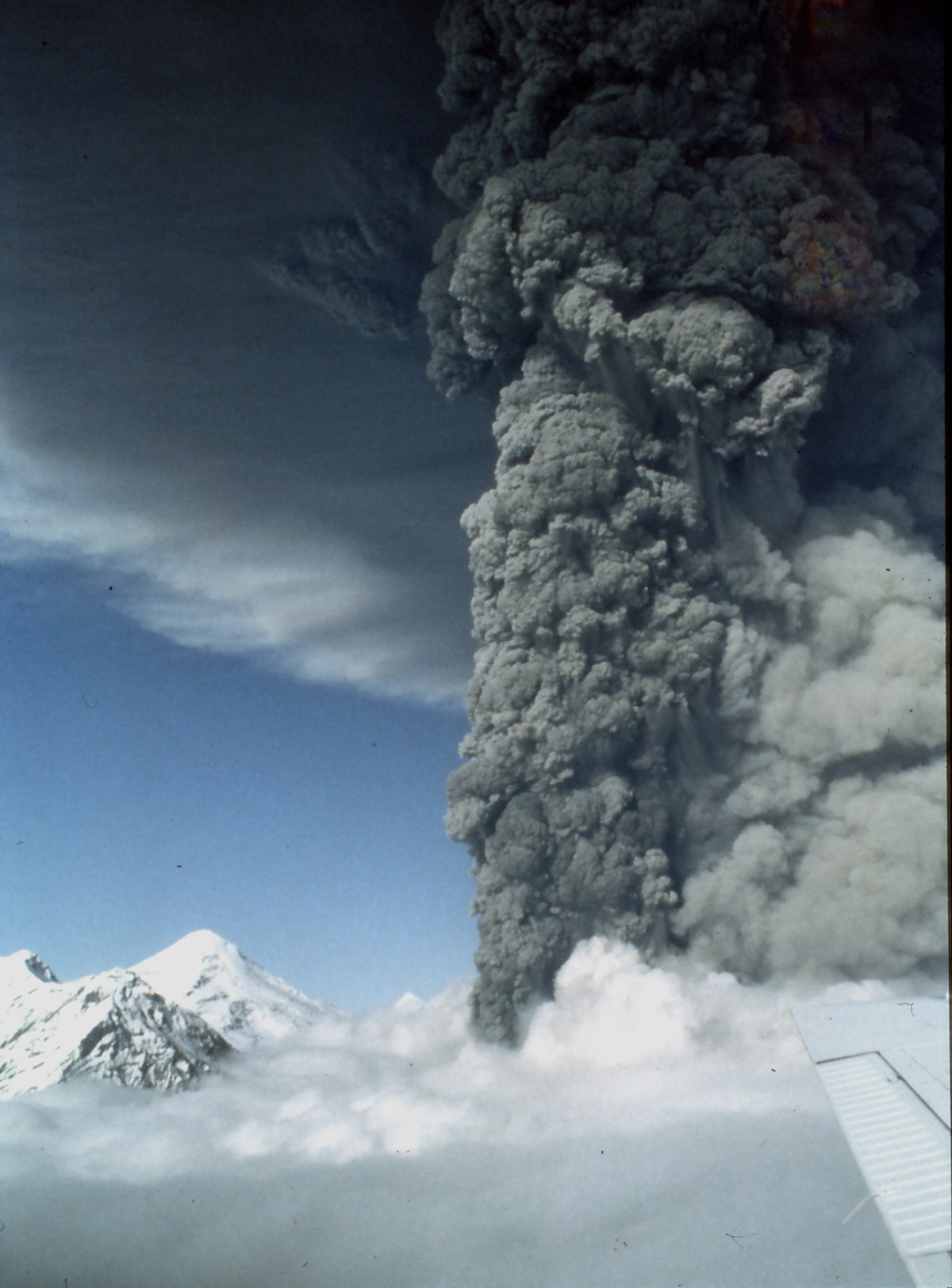
As a child, sometimes it takes a little while for logic to kick in. I was outside one July morning in Anchorage, playing with the boy who lived in the apartment above us. We were absorbed in building a road with his Tonka trucks, when he looked up and said, “I have to go in now. It’s getting dark out and I have to go in when it gets dark.” I was annoyed at having our construction project cut short, but started to pick up our toys when it struck me. “Wait a minute! How can it be dark? We haven’t even had lunch yet.”

I went inside and told my mother it was getting dark out, and she immediately rushed out to take the laundry off the clothesline, thinking it was going to rain. Instead, she saw fine gray ash falling from the sky. She turned on the radio, and we learned that Mt. Spurr had erupted.

Alaska is a land of extremes. It’s big, it’s cold, it has gigantic mountains and vast tundra, nearly constant earthquakes (most too slight to feel)… and volcanoes. Part of the Pacific Ring of Fire, Alaska has more than 130 volcanoes, 50 of which have been active in the past 250 years. In fact, there have been more than 240 confirmed eruptions in that time. There have been several eruptions in recent memory that impacted Alaska, but this is the one I experienced.

The first thing my mother did was run back out to take the clothes off the line. The radio announcer was telling listeners that the ash would bleach the color out of wet laundry. More on that later.

Before long it was so dark outside that it was hard to see, despite the street lights having come on automatically. Most businesses closed, and my Dad came home telling us that it was getting dangerous to drive on the street, because you couldn’t see anything.

What I remember most was peeking out the door and seeing that fine ash, almost like talcum powder, falling from the dark sky, and the absolute silence. Nothing was moving, and whatever noise there might have been was muffled by the falling ash.

Anchorage ended up being covered with a quarter inch of ash, while some other areas of Alaska received several inches. Because it was so fine, it filtered everywhere. Everyone was commenting on how hard it was to find and banish the ash from cracks and crevices.

My mother complained longer than anyone, I think, and it was my fault. You see, when you’re seven years old in a town like Anchorage of the 1950s, you can find all sorts of interesting places to play. For instance, the construction yard down the street where they tossed the old tires from big heavy equipment. Those huge tires were a great place to crawl around and hide in. And after the volcano, the tire wells were filled with that powdery gray ash. I loved getting in there and touching the ash; it was so soft and pretty.

Now, we weren’t supposed to be playing in the construction yard, so our parents couldn’t figure out where all the ash was coming from. For weeks I would come home covered with ash, and of course, when my mother washed my clothes the chemicals in the ash would bleach them. I happily wore my clothes with all the little white spots on them, and never did tell my mother where we were finding the ash. To this day I can still remember the wonderful feel of that soft gray powder.

Sometimes a disaster in one way can be a boon in another way. You just have to figure out what to do with the ashes.

Good Friday Earthquake, Part 3

Random Tales from the Earthquake

The woman who led our volunteer organization for servicemen was driving in downtown Anchorage. When the shaking started she pulled to the curb and stayed in the car. There was a man on the sidewalk next to her holding on to a pole with a sign stating “No Stopping or Standing”. After it was over they all just stared in shock, looking at each other. Then he looked up at the sign and said, “Well, I wasn’t really standing, you know.”

A local Anchorage store put a sign on their door that said, “Closed due to a shakeup in management.”

My mother had a friend who was a bartender in one of the bars that was part of the area downtown that sank 20 feet or so. He said there was a patron sitting at the bar who never moved from his barstool through the whole quake. After it was over, he proudly held up his glass and said, “I didn’t spill a drop!”

I was senior at West Anchorage High School, and the second floor of the school collapsed during the quake. We finished the year doing split shifts at East High. However, our graduation announcements, ordered months before, still held a drawing of the school. I sent them out to family and friends with a note telling everyone it was just the latest “Earthquake Joke.” West High is still there, but it’s only one story now. Although the main stairway still exists; it just doesn’t go anywhere.

Our senior prom was delayed, and we ended up having it at Ft. Richardson a week or two later than planned. And graduation, instead of taking place in the West High auditorium, was held in an airplane hanger on Elmendorf Air Force Base. It was an experience to remember!

While greatly damaged, Anchorage was by no means the hardest hit. Valdez was completely destroyed, with a large part of the town sinking into the sea. The town was relocated four miles away, where today it is the terminus of the Alaska Pipeline. Seward was also hard hit, first by a tsunami, and then fires from damaged fuel storage tanks near the docks. It was cut off for several days, since the Seward Highway and the railroad were impassible. Seward is situated on Resurrection Bay, wedged between the sea and the mountains, with only the one way in and out.

I got a first-hand report from a schoolmate, who had gone to Seward for the Easter break to stay with her mother, who worked there. She told me that after the shaking stopped she started to run to where her mother worked, but she was stopped by a man who told her they needed to go up the mountain. He pointed to the sea, which had emptied out a good portion of the bay. He knew what she didn’t: that a tidal wave was coming. Seward got not just one wave, but several. They ended up spending the night on the side of the mountain, along with many others. It was cold, so he gave her his jacket. When she told me her story, she said she never found out who the man was, but she still had his jacket. Oh, and her Mom was OK. She was also on the mountain, but in a different area.

Alaska’s Good Friday Earthquake

One of the most significant events in my life was the Good Friday Earthquake, and I have a bunch of stories about it. To start, I’ll just describe what happened that day from my point of view. Later on I’ll do some blogs about other stories and facts about the earthquake. 

On March 27, 1964, a 9.3 earthquake hit Alaska at about 5:35 in the evening. If you’re not familiar with what that 9.3 means, it was the largest earthquake ever to hit North America. If you remember the earthquake that brought the World Series to a halt in San Francisco in 1989, that one lasted 15 seconds and was magnitude 6.9. The Alaska quake lasted FIVE MINUTES, and at 9.3 was 250 times stronger. It was so strong that it caused a measurable surge in the ocean in Australia!

For us, the earthquake started slow. I was a high school senior, at home in an Anchorage suburb, and in the process of giving a home permanent to a young girl who was staying with us at the time. We were at the kitchen table and I saw the hanging lamp over the table start to sway. As always, I said “We’re having an earthquake” and as always, my mother said “Nah.” Earthquakes were no big deal in Alaska and we had experienced many. They really weren’t much more than conversation fodder. I was just pointing out the light swaying when everything went WHAM! 

I moved to the kitchen counter, trying to hold the cabinets closed so I could save my mother’s china. I looked through the pass-through into the living room and saw our little dog narrowly miss getting crushed by our big console TV. She ended up cowering under the coffee table. At the same time everything was flying off the counters. There was sugar, butter, coffee, and everything else hitting the floor. When the coffee pot fell on my foot my mother shouted to me to let it all go and get out of the house. As soon as I stopped holding the cabinet doors every piece of china hit the floor.

At some point my mother said she thought it was the end of the world, because it was dusk on Good Friday. This from a woman who hadn’t been to church in thirty years.

About that time my old boyfriend stumbled through the door-what rotten timing! He had a shocked look on his face, and even more so when my mother ran to him (she never liked him). We all just held on until the shaking stopped, and then I started moving through the house trying to put things to right. It was clear that the movement had been mostly in one direction, because items on the North and South walls were thrown to the floor while the other walls were fairly stable. 

My first order of business was to take the water out of the toilet tank to rinse the permanent solution out of our young guest’s hair. Even that was a challenge, because the stacked washer and dryer in the bathroom had walked out from the wall to block the door. I ended up going outside and crawling in the bathroom window so I could push them back to the wall. Then I turned on our radio that received short wave broadcasts. When we heard calls for assistance in the Turnagain subdivision, my friend and I decided to drive out to see if we could help.  As we drove out we saw a lot of damage like broken windows in some businesses, but I don’t think the full impact of the disaster had really hit us yet. We knew it was big, but didn’t yet appreciate how big.

When we got to Turnagain my friend said he said he was lost and stopped near a group of people standing on the cliff overlooking the inlet. We walked over to talk to them and realized the reason he was lost was because most of the neighborhood was gone.  To my young eyes it looked like utter devastation. As far as I could see there were broken houses, and all I could think of was how many people might be trapped there, where we couldn’t get to them.

My friend was an announcer at a local radio station, so we decided to go help them get back on the air. When we arrived at the station, we had to help dig the announcer out, because there was a long hallway leading to the broadcast booth and it was blocked with tapes and records that had been on shelves lining the hall. The announcer was fine but he couldn’t get the door open!

We returned to my house, driving past my high school, and that was the first time I realized that the second floor had collapsed.  I was only two months from graduation and my school was gone! We got warm clothing and blankets for everyone. We had no electricity or water, but the radio station gave instructions on how to make snow safe to drink. We treated a little snow to get us through the night.  We tucked our young guest into bed, and my mom retreated to her bedroom with extra blankets and bottle of Dewars. To the end of her life she claimed that was the best antidote for cold. My friend and I spent the night listening to the radio. I wanted to sleep, but the occasional aftershock had me stressed out and I couldn’t really relax enough to sleep.  We listened to the lists of missing and the tsunami warnings. In time most of the names I recognized on the missing list were found…except for one. He was found under the collapsed front wall of the Penney’s department store.

It was the next day before we fully appreciated the extent of the damage. While Anchorage was hit hard, there were towns and villages that were completely destroyed, and a good part of the map of Alaska was changed. I’ll post more of the story, along with some photos, in the coming days.

About My Stories…

Since I decided to start blogging again, I started to think about the stories I plan to tell. So: Pay Attention Please! 

I tell different types of stories. There are stories, memories, and musings. All my stories are based in fact. However, they are created to entertain. When I told stories to my tour guests, I usually ended with the statement: “This story is true. Mostly.” So my stories will be true. Mostly.

When I relate a memory, it is as true as my flawed memory will allow. Have you ever returned to a place that was smaller than you remembered, or come across an old flame who is less enticing than your memories of them? Events end up getting filed into our memories, and then they get dusted with the fairy dust of years and come out again somewhat changed. So forgive me if I report something that might be a bit off.

As far as musings are concerned, those are just the weird crap that pops into my mind. I usually tell those to the mirror as I’m getting ready for the day, but now I’ll put some of them down here.

Alaska As I Remember It

The Fourth of July. Usually it passes mostly unremarked here…we have guests to attend to, buses to run, vacation dreams to fulfill. Oh, we do have a cookout and some games, but it’s still a workday.

This year was different, however. I was invited to the celebration in the town of Ferry, which, until the day before, I didn’t even know existed. I have a distant relative, whom I’ve only met once before, who lives in Ferry, Alaska. My sister-in-law has encouraged us to get together, but it didn’t really register how very close they live. Anyway, my cousin-by-marriage called me the night before the 4th and invited me to come to their town cookout. It turned out to be much more than I expected, and a delightful time.

I agreed to come after work, and I got the directions of how to get to the town. It went along the lines of: drive to milepost xxx on the Parks Highway and take the Ferry Road (which, by the way, is unmarked) to the railroad tracks. Then turn left and follow the tracks until you come to a lot of cars. Wait there to be picked up. I did all that. There’s a railroad bridge that crosses the Nenana River. Shortly after I arrived, here came my cousin on an ATV over a walkway on the bridge. I climbed on the back of the ATV and off we went, back over the river to Ferry.

I walked into an Alaska I remember from my childhood. Our host was an true Alaskan old fart who welcomed me with a kiss on the hand and an offer of food. His hand-built log cabin is a step back into history, obviously hand-built. Their “community center” was at one time the post office-also a log cabin that was turned over to Ferry when the Parks Highway was built and mail started being delivered to mailboxes on the highway rather than by the train. It has a bar, a sitting area with an original barber chair, a pool table, and enough memorabilia to make an antique lover swoon.

I also got a tour of our host’s cabin. So here, in the Alaskan bush, in the cabin of this 80-something sourdough, sits a baby grand piano. How did it get there? Well, the good citizens of Ferry carried it across the railroad bridge. Ah, the railroad bridge. That’s a whole other story. It turns out that the town of Ferry is quite famous. Maybe I’ll write the whole story once I get it right from the mouths of those who know the real story-the residents of Ferry. For now, let me entice you with a promise to tell the story of the Ferry Moon.

But Ferry isn’t completely Alaska Bush. In fact, one of the folks there said they live in the “Cush Bush”. Yes, they are highly spread out (I didn’t actually see any homes other than our host’s-people in Alaska like their neighbors to be close enough to visit…but not too often). Yes, they have well water and outhouses. But they also have electricity and 4G internet and cell service. Turns out the cell tower is right in town.

The town fascinates me, and I assured both my cousin and my host that I’d be back to visit. I itched to take time to really photograph this remnant of Alaskana, but it didn’t seem polite. Next time I’ll take my camera, and ask permission. There are literally hundreds of photos sitting there waiting to be made.

Living In Cold Country

Growing up in both Cut Bank, Montana and in Alaska means that sub-zero weather isn’t a new phenomenon to me. Yes, I walked to school  at -42 degrees, in the snow…uphill both ways. But many years of living in San Diego and the Phoenix area have spoiled me.

In those cities you wake up in the morning knowing the sun will be shining, and at the very worst you might have to wear a sweater. Being in Healy, Alaska during the coldest April they’ve had in many years takes some getting used to!

The first thing I had to (re)learn was that wearing earrings when it’s -15 isn’t a wise move. After the first time, the earrings went into the drawer until it gets warmer. (The frostbite is almost healed.) (Wink)

The second thing is that while the snow may have been melting yesterday, this morning it’s frozen again. So under that new dusting of snow, there’s a perfect skating rink. Step with care!

And then I’ve also learned that Spring wants to tease you. You get a couple of days in the 40s, you start thinking that Breakup is here. You convince yourself that soon the ice will go out and you’ll be able to see the river running. Before long the trees will start to green up and summer will be upon us. You start peeking at the sky, hoping to see a migrating bird coming through to tell you winter is finally over. All you see is another raven. 

And then the next morning you look out the window and discover another six inches of snow. And the doggone ravens.

Trains

Living in Denali has brought me back to a memory of my childhood. I grew up in both Alaska and Montana. Please don’t ask me how much time I spent in each-I’m getting old and having trouble remembering what I did yesterday, let alone what happened fifty to sixty years ago. The bare bones are that I was born in Montana and first went to Alaska when I was six. From then until my Junior year of high school, where I lived depended on what stage of marriage my mother was in. I did spend my last two years of high school in Anchorage, and graduated from there. But I attend the Cut Bank, Montana high school reunions. Go figure. But I digress.

Growing up in Montana, I grew itchy feet early on. Inherited from my much-married mother, I suspect. We lived in a house on the edge of town overlooking the railroad trestle off in the distance. I spent many hours sitting in front of the big picture window watching the trains go by. I’d count the cars in the long trains pulling the oil tankers from the refinery outside of town. And I’d watch the Empire Builder, wondering where the people on board were going. Were they headed to Chicago? To Seattle? Somewhere even farther and more exotic? Like Minneapolis? (I was a kid. My geography wasn’t always accurate.)

So that’s a long intro to the trains of Denali. I’m again living in a place where I can see the trains go by-now they are Alaska Railroad trains and the river is the Nenana River. And my bedroom is situated so I can hear them rumble by. Those trains are the lifeblood of this area. They bring the guests for the hotels and the National Park, and they carry the coal from the coal mine in Healy. The trains during the day are the people movers, and at night the coal train starts its trek to the coast for shipment. I can lie in bed at night and hear the train rumble by, sometimes for a long time-lots of coal going somewhere. At first it was a little disconcerting, but then I started remembering the trains of Montana. Now I can listen to the rumble and know how lucky I am. Now I’m in one of those exotic places I wanted to go.

Starting a New Adventure

Last summer’s trip to Yellowstone and Glacier prompted me to think about seasonal jobs. Remembering a conversation with an employee in Denali Park a few years ago, I decided to apply. So today I sit in Anchorage, getting ready to leave for Denali. This will be the record of my summer adventure.

First, it isn’t summer here. I left Phoenix three days ago after a couple of 100 degree days, and arrived here to mid-50s. Although I spent a lot of my childhood in Anchorage and graduated from high school here, I find the city barely recognizable. Controlled-access roads where there used to be gravel trails. Hotels where I used to live. And my favorite bar, which started out in the late 60s as a log cabin with soft chairs and a fireplace, is now a two-story giant sports bar.

Some things don’t change, though. Heading out to pick up some items from the store yesterday, I first encountered hills that seemed out of place. Turned out they are the leftover snow from winter that got dumped there after they cleared the roads. It had to go somewhere, you know. And on the way back to the hotel, traffic slowed to a crawl to allow a moose to cross the road.

And the light. It’s different here than in the desert. Most of the time since I arrived it’s been overcast, which I remember to be a pretty common state of affairs. But then late in the day, as the sun gets lower, it peeks under the clouds and hits the mountains. Anchorage is surrounded by mountains, still covered with snow at this time of the year. They light up and glow with the sunset, blue and white and jagged against the sky. It brings so many memories of my younger years, when the mountains were the backdrop to my life.