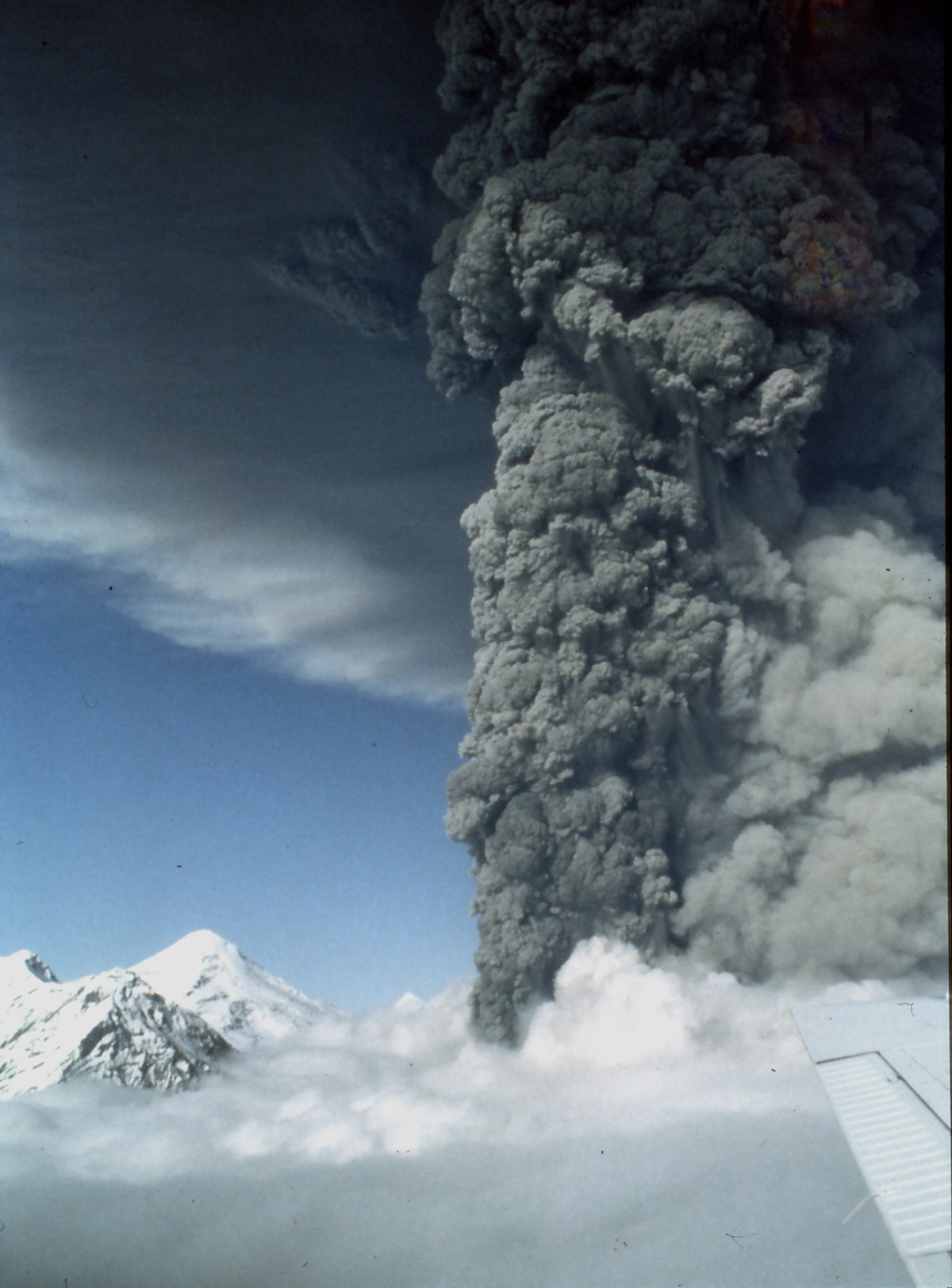
As a child, sometimes it takes a little while for logic to kick in. I was outside one July morning in Anchorage, playing with the boy who lived in the apartment above us. We were absorbed in building a road with his Tonka trucks, when he looked up and said, “I have to go in now. It’s getting dark out and I have to go in when it gets dark.” I was annoyed at having our construction project cut short, but started to pick up our toys when it struck me. “Wait a minute! How can it be dark? We haven’t even had lunch yet.”
I went inside and told my mother it was getting dark out, and she immediately rushed out to take the laundry off the clothesline, thinking it was going to rain. Instead, she saw fine gray ash falling from the sky. She turned on the radio, and we learned that Mt. Spurr had erupted.
Alaska is a land of extremes. It’s big, it’s cold, it has gigantic mountains and vast tundra, nearly constant earthquakes (most too slight to feel)… and volcanoes. Part of the Pacific Ring of Fire, Alaska has more than 130 volcanoes, 50 of which have been active in the past 250 years. In fact, there have been more than 240 confirmed eruptions in that time. There have been several eruptions in recent memory that impacted Alaska, but this is the one I experienced.
The first thing my mother did was run back out to take the clothes off the line. The radio announcer was telling listeners that the ash would bleach the color out of wet laundry. More on that later.
Before long it was so dark outside that it was hard to see, despite the street lights having come on automatically. Most businesses closed, and my Dad came home telling us that it was getting dangerous to drive on the street, because you couldn’t see anything.
What I remember most was peeking out the door and seeing that fine ash, almost like talcum powder, falling from the dark sky, and the absolute silence. Nothing was moving, and whatever noise there might have been was muffled by the falling ash.
Anchorage ended up being covered with a quarter inch of ash, while some other areas of Alaska received several inches. Because it was so fine, it filtered everywhere. Everyone was commenting on how hard it was to find and banish the ash from cracks and crevices.
My mother complained longer than anyone, I think, and it was my fault. You see, when you’re seven years old in a town like Anchorage of the 1950s, you can find all sorts of interesting places to play. For instance, the construction yard down the street where they tossed the old tires from big heavy equipment. Those huge tires were a great place to crawl around and hide in. And after the volcano, the tire wells were filled with that powdery gray ash. I loved getting in there and touching the ash; it was so soft and pretty.
Now, we weren’t supposed to be playing in the construction yard, so our parents couldn’t figure out where all the ash was coming from. For weeks I would come home covered with ash, and of course, when my mother washed my clothes the chemicals in the ash would bleach them. I happily wore my clothes with all the little white spots on them, and never did tell my mother where we were finding the ash. To this day I can still remember the wonderful feel of that soft gray powder.
Sometimes a disaster in one way can be a boon in another way. You just have to figure out what to do with the ashes.

 Travels with Billie
Billie… another great personal blog. Occasionally in Hawaii also…you get an eruption and are beset with ash and Vog. When you and Rich had the condo in Kona you probably saw some of that. But here you frame it well from a playing child’s perspective. Interesting way of seeing it. A kind of “making strange” to the reader (Russian literary term of the Formalists was “остранение” (literally the device of “stranging” Lee
>